Tara: Mother of Liberation & All Buddhas
In Tibetan and Mahayana Buddhism, Tara (often called the "Mother of Liberation" or the "Mother of all Buddhas") is a revered, fully enlightened female Buddha and Bodhisattva. She symbolizes universal compassion and the ultimate, perfected wisdom that leads all beings to enlightenment.
Origin and Essence
- How She Was Born: One of the most popular stories tells that she sprang from a teardrop wept by Avalokiteśvara (the Bodhisattva of Compassion). As the tear fell, it created a lake, and from its waters arose Tara, who vowed to assist him in liberating all beings from suffering. But is is also believed that she is primordial and has never not existed....some say the earth herself is Tara-Terra Firma
- "Mother of All Buddhas": She earned this title because she embodies the Prajnaparamita (the perfection of wisdom). In Buddhism, wisdom is the feminine principle; when combined with compassion (the masculine principle), it births enlightenment. Therefore, all Buddhas ultimately rely on Tara's wisdom to awaken.
- The Savioress: The name Tara means "star" in Sanskrit. She is viewed as a guiding star that safely navigates practitioners across the ocean of samsara (the cycle of rebirth and suffering).
Primary Forms
Tara has 21 widely recognized forms, but two are most prominent in daily practice: 4]
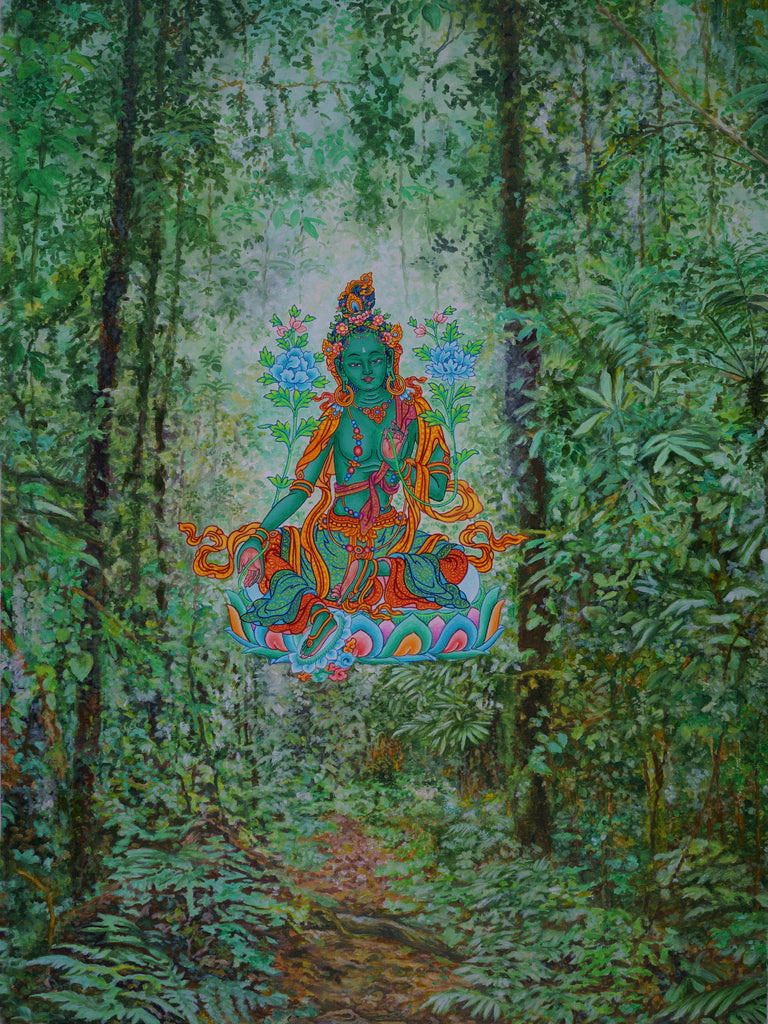
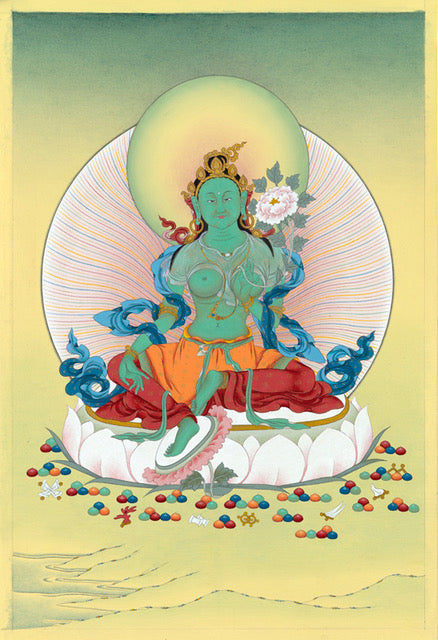
- Green Tara: Known as the "Swift One," she embodies immediate, active compassion and rescues beings from fear and danger. She is often depicted with her right leg extended, ready to jump to the aid of those who call upon her.
- White Tara: She embodies enlightened wisdom, health, and long life. She is primarily invoked for healing, longevity, and peace.
How to Practice with Tara
Practitioners connect with Tara to seek protection from obstacles, both spiritual and worldly.
- Her Mantra: The most common Green Tara mantra is Om Tare Tuttare Ture Soha. Devotees recite this mantra to invoke her blessings, which translate roughly to a plea for protection and the embodiment of her enlightened actions within one's own heart.
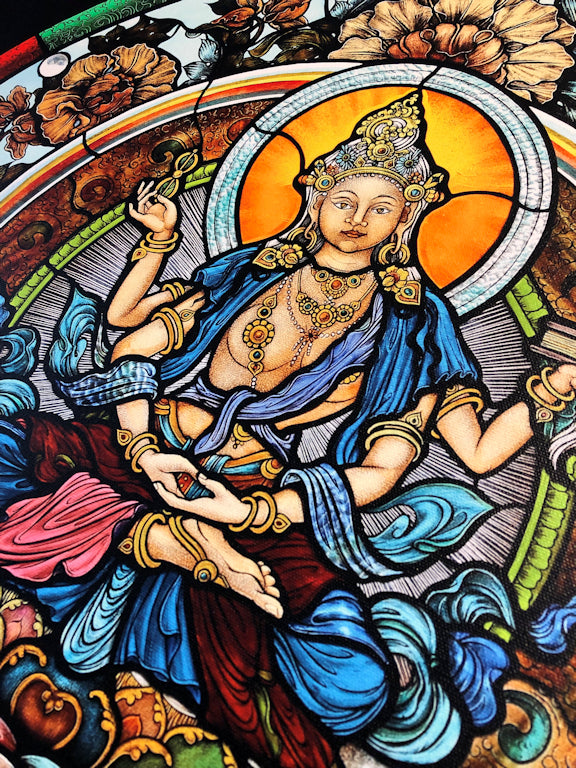
- Iconography: She is typically depicted sitting in a relaxed "pose of royal ease," holding a lotus flower, which signifies both purity and swift action. [1, 2]

-
Yulokod: The Pure Realm of The Divine Female Buddha Tara
I came to a place where the entire country was verdant wherever I looked,
beautiful and vividly clear, a marvelous environment with many
extraordinary features.
Pavilions of five-coloured rainbow light hovered
in the sky.
Many kinds of flowers and lotuses grew everywhere. Here there
was no concept of summer or winter.
The wish granting trees were in full
leaf, and from the words of Buddhadharma in the Sanskrit language, such as
Namo arya tare mam.
Birds that were emanations of the Noble Lady-sparrows,
ducks, peacock, cranes, parrots, grouse, cuckoos, and swans, played
everywhere.
The land was filled with wealth and prosperity gems.
Everywhere were pools of nectar endowed with eight fine qualities and
elegantly appointed bathhouses made of precious jewels.In this realm, there was no concept of birth, aging, illness or death.
All of the inhabitants were born miraculously from the hearts of lotuses.
In no future lifetimes would they hear unpleasant or discordant sound.
Those dwelling there were bodhisattvas who had attained high levels of
realization.
This place surpassed the limits of imagination; its size
could not be measured.
It contained thousands of immeasurable mansions
fashioned of the five precious substances.
I arrived at the gateway of the central palace, a vast celestial mansion
of magical and marvelous appearance, having the power to liberate beings in
four ways.
The very moment I entered it, I awoke from deep sleep of
ordinary rational consciousness and was free of the veils of ignorance.
The
inner vision of my pristine awareness expanded, and I experienced a surge
of love and compassion.
I came to a courtyard in which many thousands of goddesses, dressed in
green, chanted the praises to the twenty-one forms of Tara in the Sanskrit
tongue.
Occasionally they played small finger cymbals, golden hand drums,
and drums made of sandalwood, ebony, serpent's heart wood, and four kinds
of heart wood, as well as cymbals, gongs and flutes.
They frequently
punctuated their chant with music performed on this inconceivable variety
of instruments.
Upon hearing them.
I felt an unimaginable sense of
devotion; I made many offering praises with my mind.I proceed to the immeasurable central palace, the celestial mansion.
I saw that the five layered walls were made of conch shell, gold, coral,
emerald, and sapphire, all with friezes of ruby. The pillars and columns
were made of red pearl, the main roof beams of quartz crystal, and the
rafters were made of gems to illuminate the interior.
Atop a cornice of gold was a pediment of coral, supporting a bluish green vault of
turquoise.
Melodious music from chimes on the roof top resounded, taking
away the suffering of those in the lower realms.
The fragrant scent of
incense of the immeasurable attitudes wafted about.
There were fine
displays of unimaginably lovely offerings.
In the center of the mansion, on a many-coloured lotus with a thousand
petals and a moon disk seat, was the only refuge, the very embodiment of
compassion, the sublime mother of all the victorious ones of the three
times, the sister of the bodhisattvas, she, whom both those in the human
world and those in the heavens worship with the crowns of their heads
touched to the soles of her feet.
The goddess who was born from the tears of the Exalted One, the noble Tara herself.Her body was bluish green, more intensely luminous than a mountain of
turquoise fit by a thousand suns.
Infinite rays of light shone from her form, which was adorned with major and minor marks of perfection.
Her body was that of a youthful maiden sixteen years of age, clad in garments made from the silk of the gods adorned with immeasurably valuable ornaments of precious wish-fulfilling gems.
Her hair was shiny jet black, half of her tresses bound up in a topknot and with ribbons of blue green silk that fluttered in the breeze. With her left hand in the gesture symbolizing the Three Jewels, she held the stem of a blue lotus, the petals of which bloomed next to her ear.
With her right hand she held the gesture of granting refuge.
She, Tara, Mother of all Buddha's sheltered all beings from the limitless fears of this confused world of cyclic existence.
She held her two legs half-crossed in the posture of a feminine bodhisattva.Many noble feminine bodhisattvas were circumambulating her and there were also many varied manifestations of Tara herself.
All were distinctly visible but without the aggregates of flesh and blood.
They appeared as illusory forms of pristine awareness, a magical display manifesting in myriad of ways.
I saw them in all their scintillating brilliance, like
stars and planets reflected in the vast ocean.
At this point, my grasping at ordinary reality spontaneously ceased & I experienced for a time an unimaginable sense of cosmic order.By Delog Dawa Drolma
From Tibe